
Last updated September 10, 2026
Full 25-point door and opener safety check with every visit - springs, cables, rollers, tracks, and your LiftMaster or Chamberlain opener included
You get a price before we start. It does not change when the truck arrives.
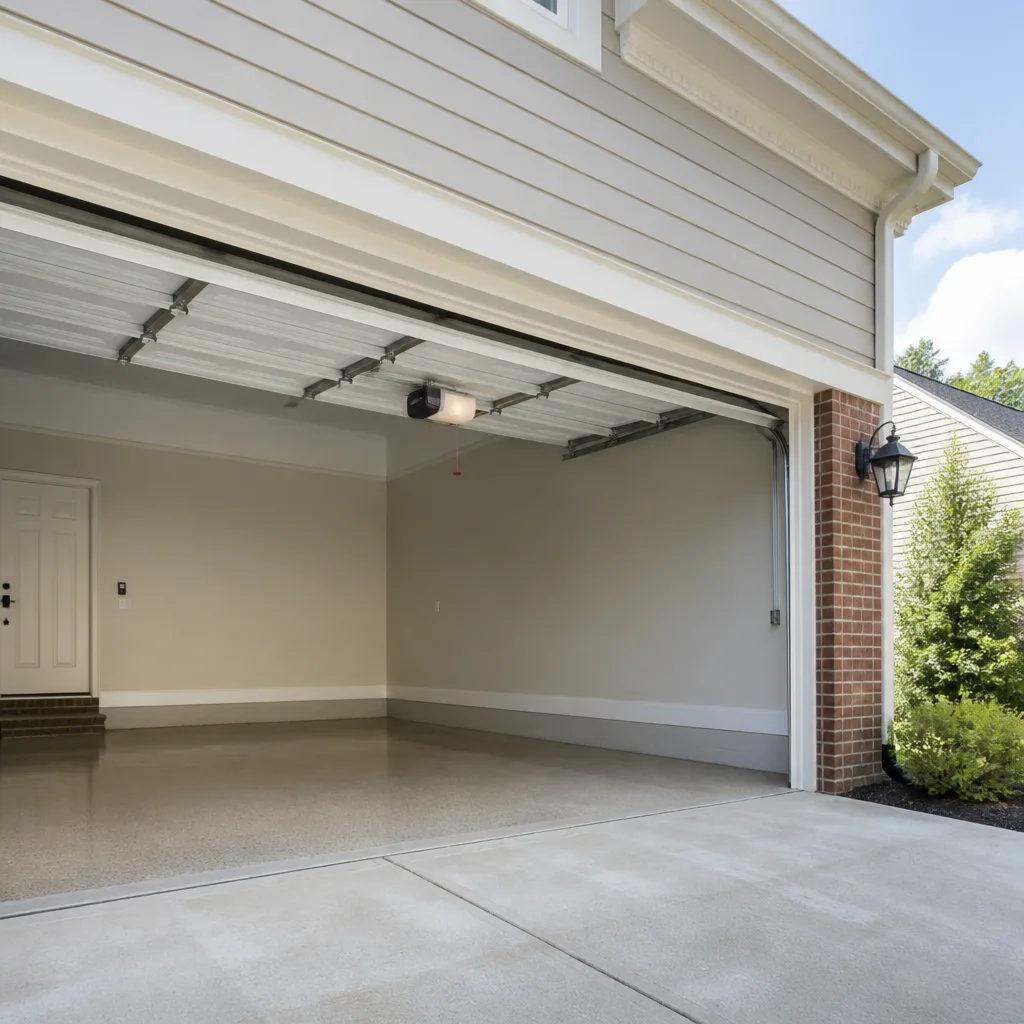
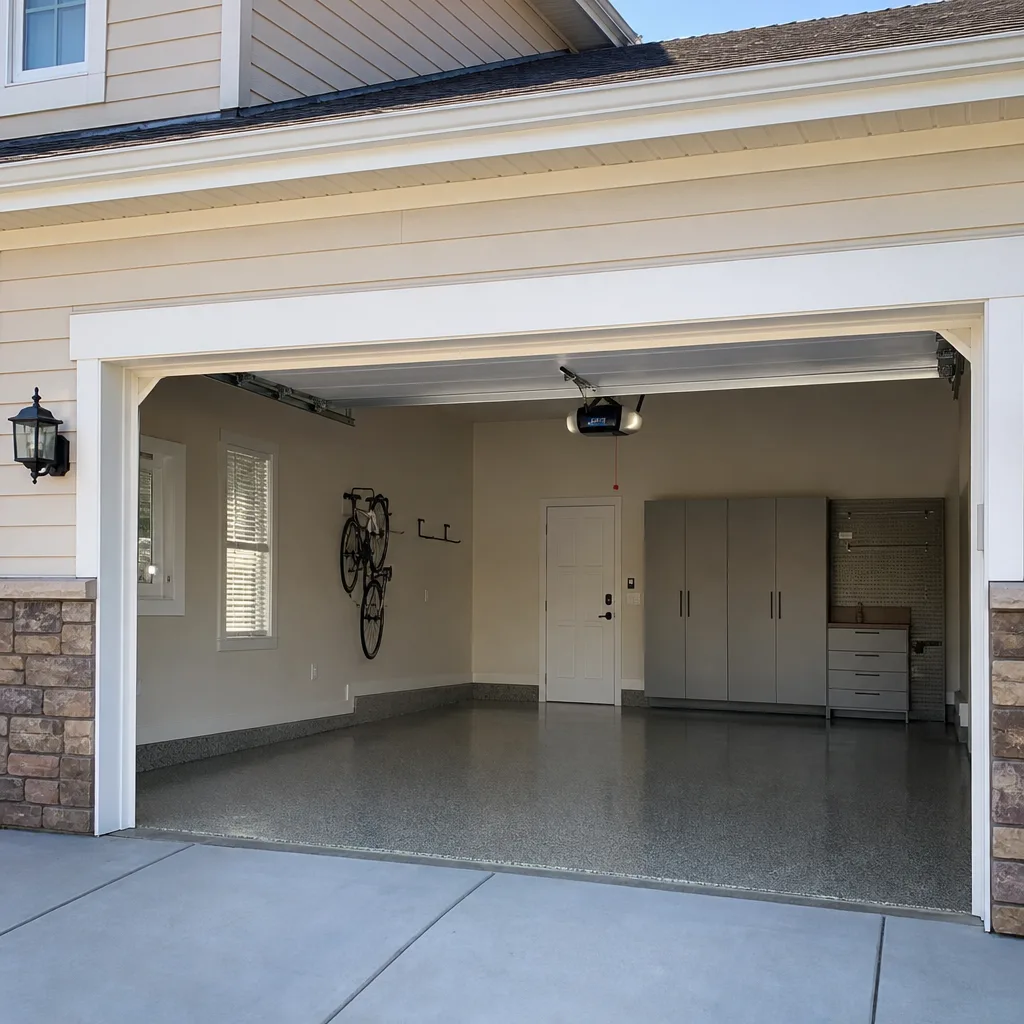
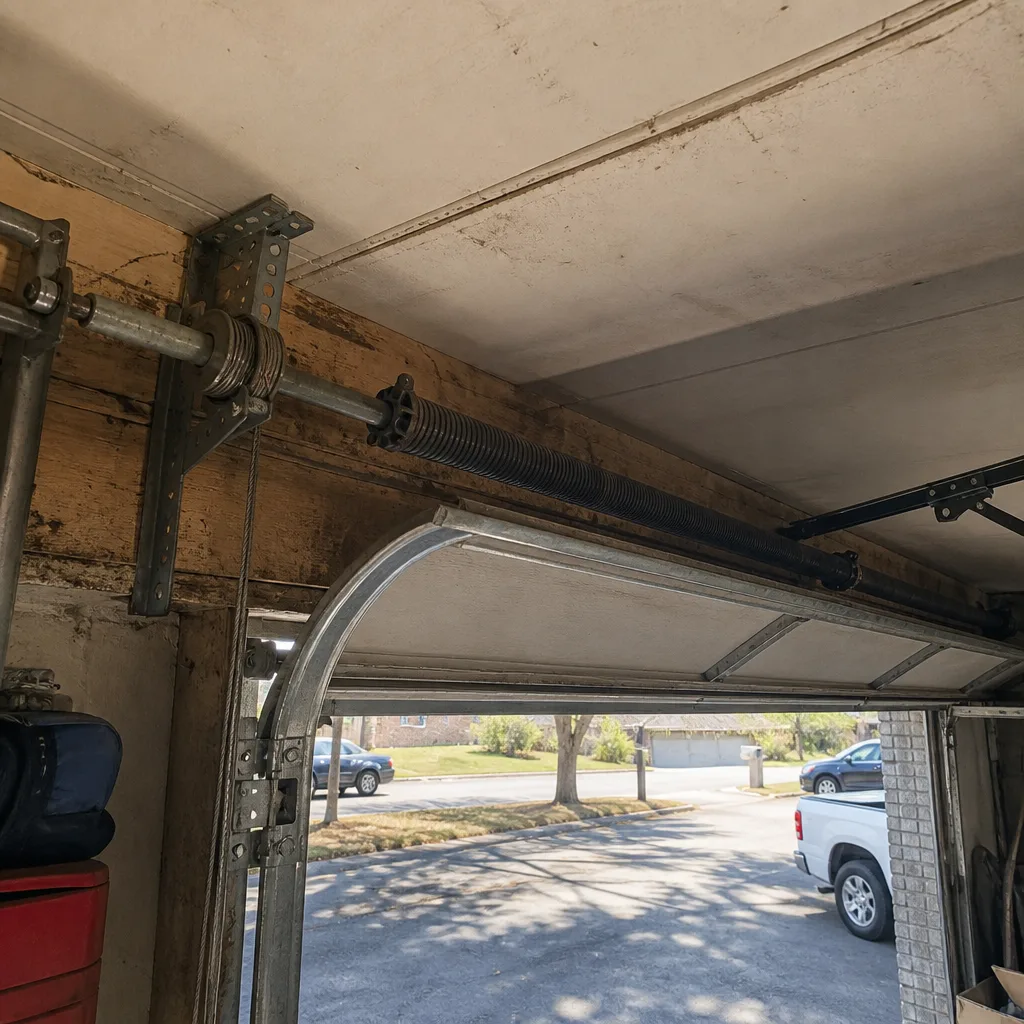 Before
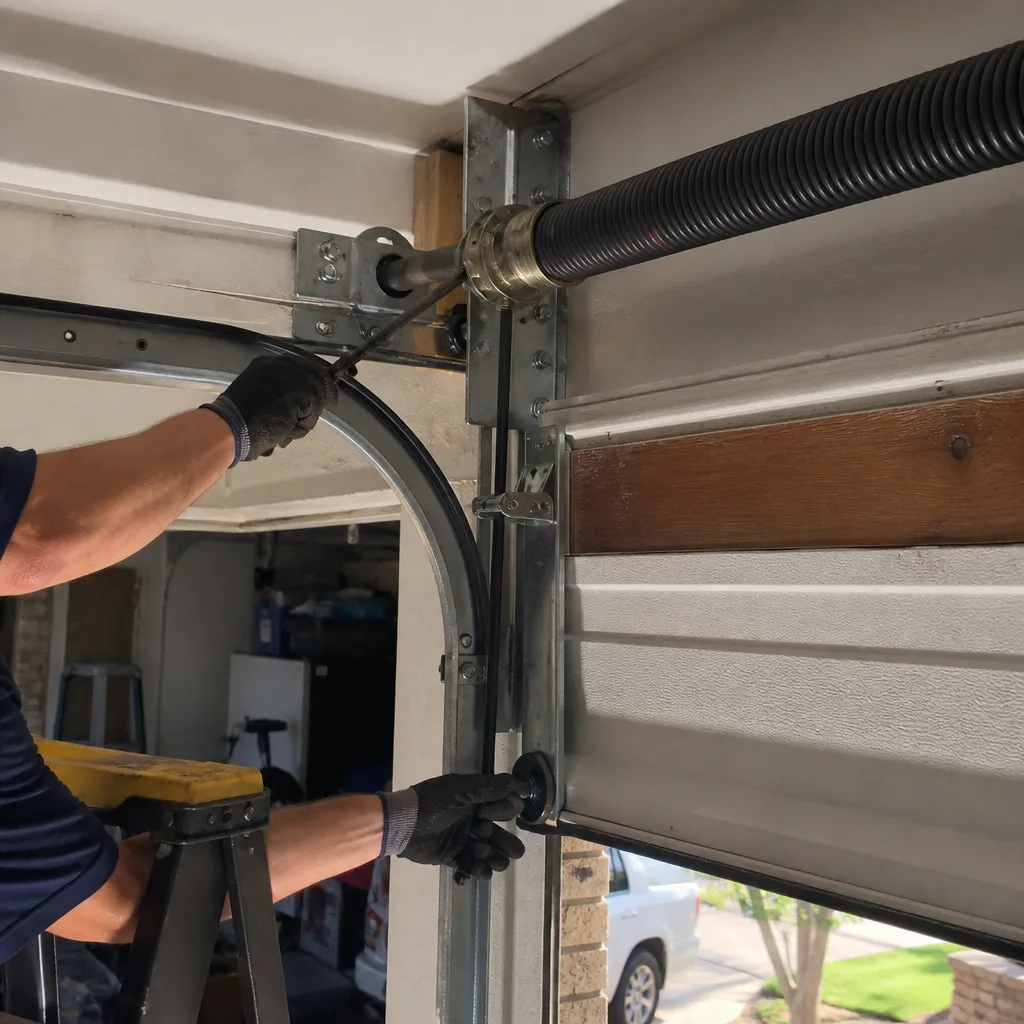 After
After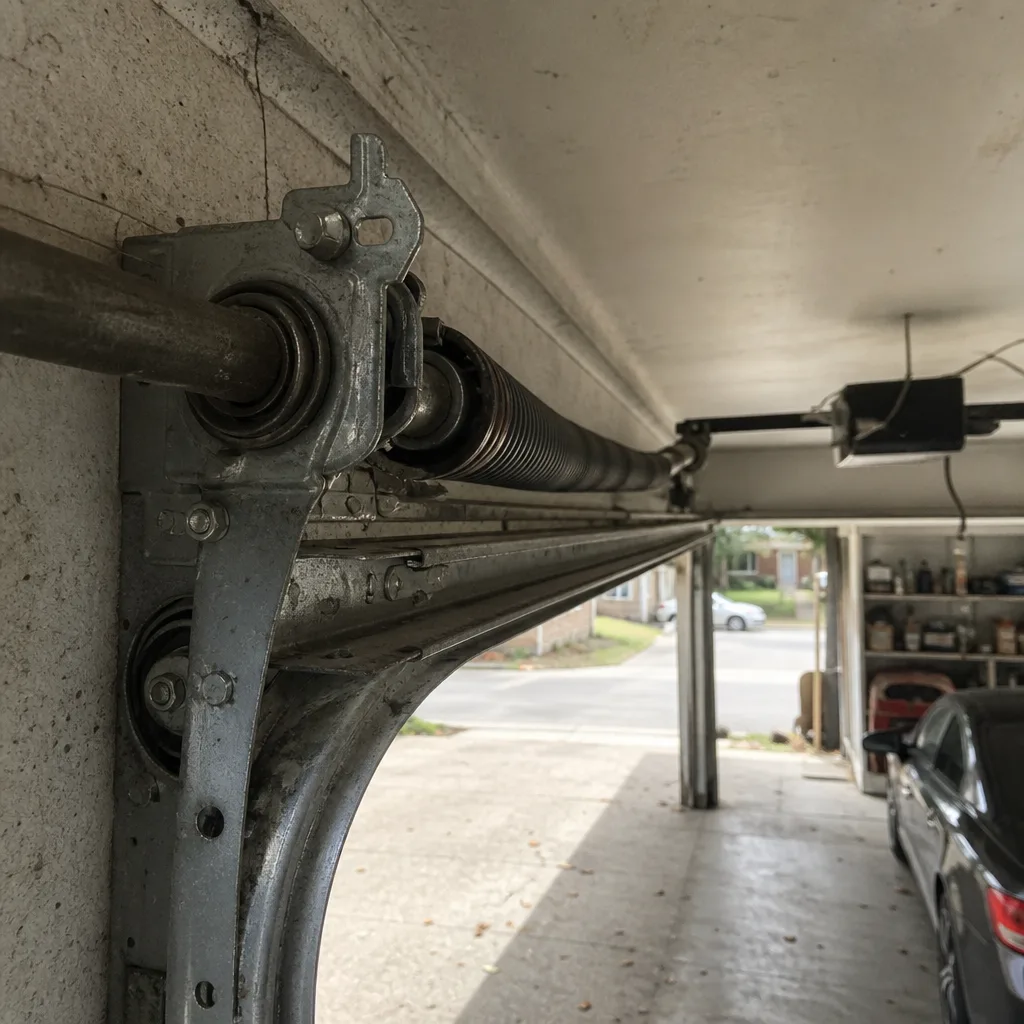 Before
 After
After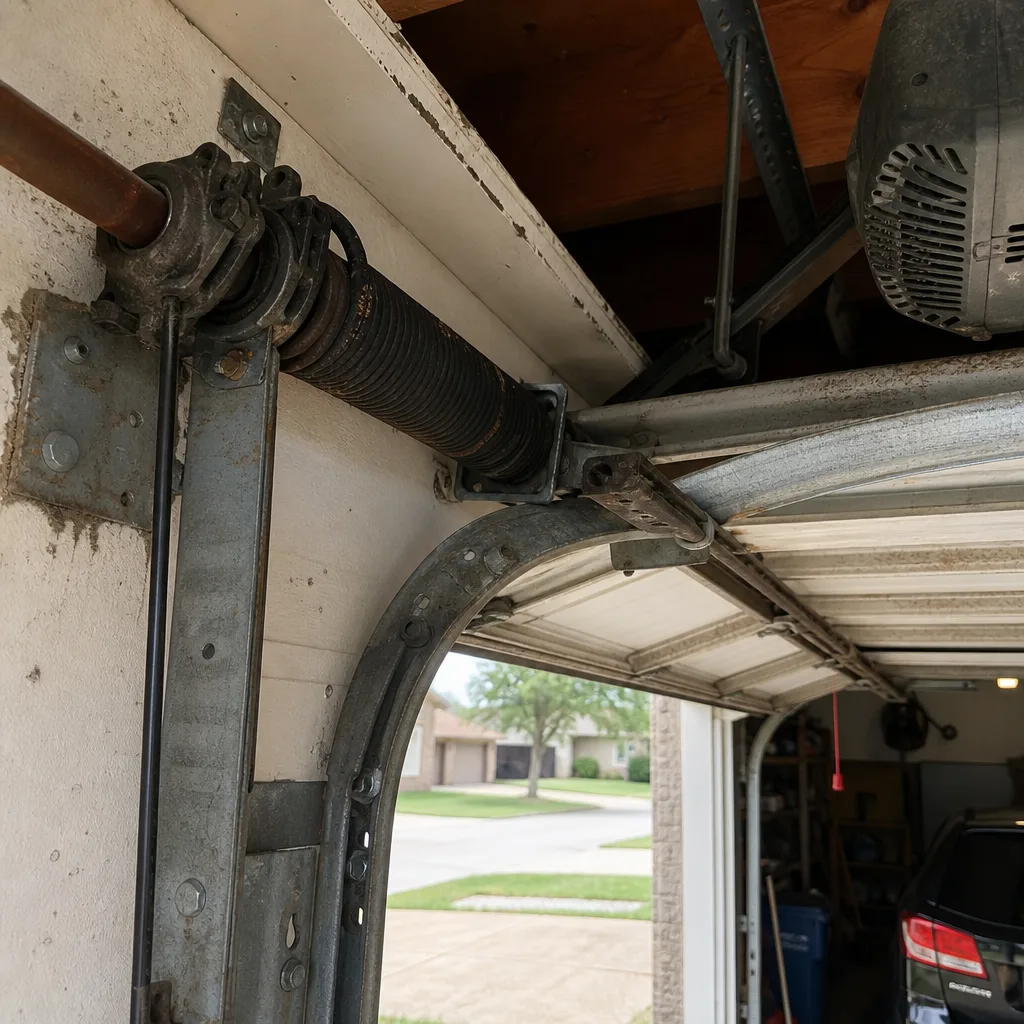 Before
 After
AfterDIY vs Professional Garage Door: The Coppell Homeowner’s Decision Guide
A torsion spring stores enough energy to break a wrist or snap a cable through a car window. Not because homeowners are careless, but because the tool required to release that energy safely costs $400 and lives in a technician’s truck. In Coppell, where summer humidity swells wooden door panels and winter cold stiffens lubricant, garage doors face stresses that make the DIY-or-professional question more than a matter of saving money. This guide draws a clear line between what you can safely handle yourself and what belongs in trained hands, with honest numbers on both sides, plus links to our Garage Door Repair Maintenance Checklist for Coppell Homeowners and more guides & resources.
Quick Answer
Most Coppell homeowners can safely handle weatherstripping, lubrication, sensor cleaning, and remote programming themselves. Spring replacement, cable work, track realignment, and opener header bracket installation require specialized tools and training. The dividing line is reversibility: if a mistake won’t damage the door or injure someone, it’s reasonable DIY territory.
Table of Contents
- What Homeowners Can Safely Do Themselves
- The Physics of Torsion Springs: What You’re Actually Working With
- Tasks That Require Trade Tools and Training
- The Hidden Cost of DIY Gone Wrong
- North Texas Hardware Store Products: Trade-Grade vs. Consumer-Grade
- The Middle Path: Helping Without Slowing Things Down
- Cost Comparison: DIY vs. Professional in Coppell
- When to Call a Professional
What Homeowners Can Safely Do Themselves
Some garage door maintenance is genuinely within reach of a careful homeowner. The key test is reversibility: if you make a mistake, can you undo it without damage or danger?
Here are the tasks we encourage Coppell homeowners to handle on their own:
- Lubrication of rollers, hinges, and the opener chain or screw. Use a silicone-based spray, not WD-40, which attracts dust. Apply sparingly, wipe excess, and run the door up and down to distribute. In Coppell’s clay-heavy soil environment, dust infiltration is real, so over-lubrication creates a grinding paste.
- Weatherstripping replacement on the bottom and sides. Measure the existing strip, buy matching profile at a local hardware store, and slide or nail into place. This is purely mechanical, with no tension or alignment consequences if the first attempt is slightly off.
- Photo-eye sensor cleaning and alignment. When the door reverses for no visible reason, the issue is usually cobwebs, leaf debris, or slight misalignment of the infrared beams. Clean both lenses with a soft cloth, check that both LED indicators match (usually solid green), and gently adjust until they do. The brackets allow fingertip adjustment, no tools required.
- Remote and keypad programming. Every major opener brand, LiftMaster, Chamberlain, Genie, includes step-by-step instructions in the manual. The process typically involves pressing a learn button on the motor unit and then a button on the remote within 30 seconds. If it doesn’t take, you simply repeat. No mechanical risk.
- Visual inspection of hardware. Look for rust on cables, cracks in rollers, or loose bolts on the track brackets. Note what you see. This information alone saves a technician time and you money.
These tasks share three characteristics: no stored energy to release, no structural load to bear, and no specialized tools beyond a screwdriver and silicone spray. In our 42 years of service, we’ve never seen a homeowner injure themselves lubricating a hinge.
The Physics of Torsion Springs: What You’re Actually Working With
A standard 16-foot wide, 200-pound steel garage door in Coppell’s newer neighborhoods like Cypress Waters or Riverchase requires roughly 10,000 inch-pounds of torque to lift. The torsion spring, mounted on a steel shaft above the door, stores this energy when wound tight. A single winding cone holds that force in check.
Here’s what those numbers mean in practice:
- The spring is under constant tension, even when the door is closed. It does not “relax.”
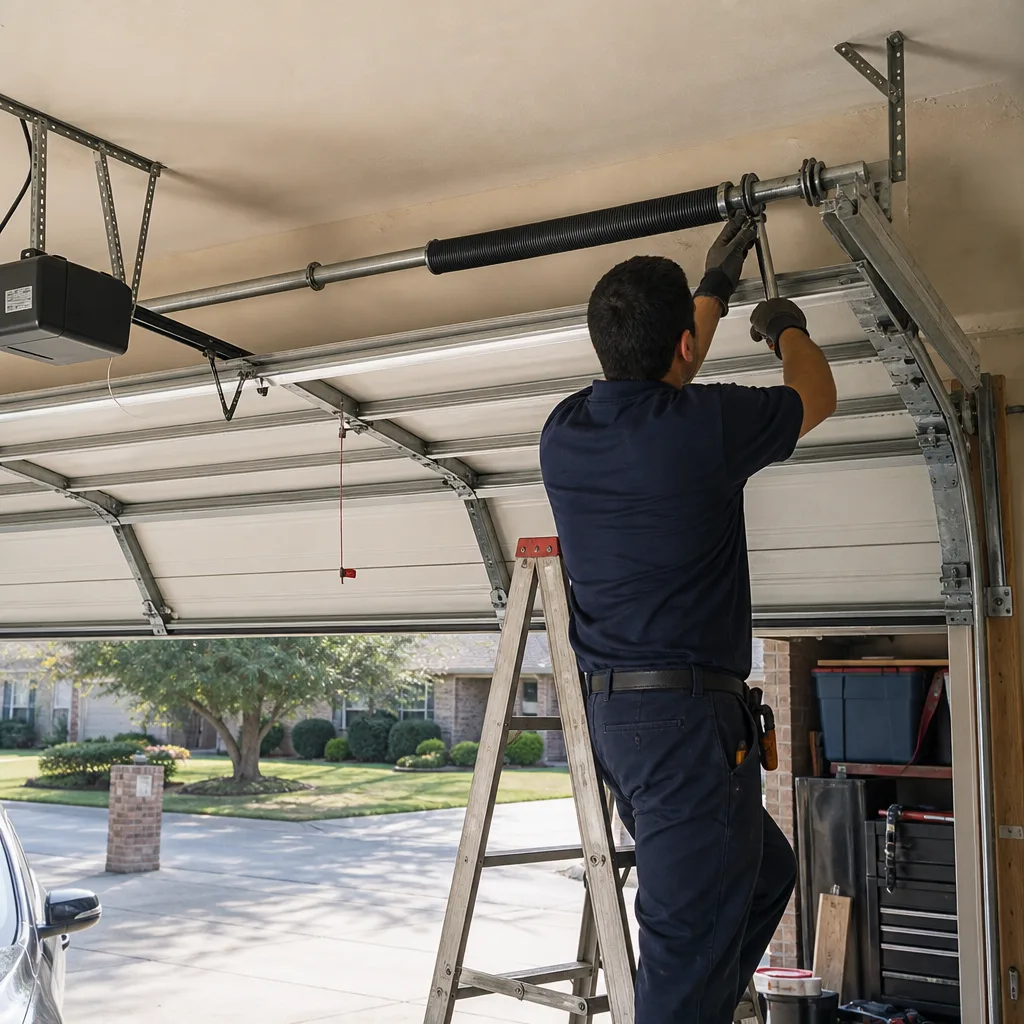
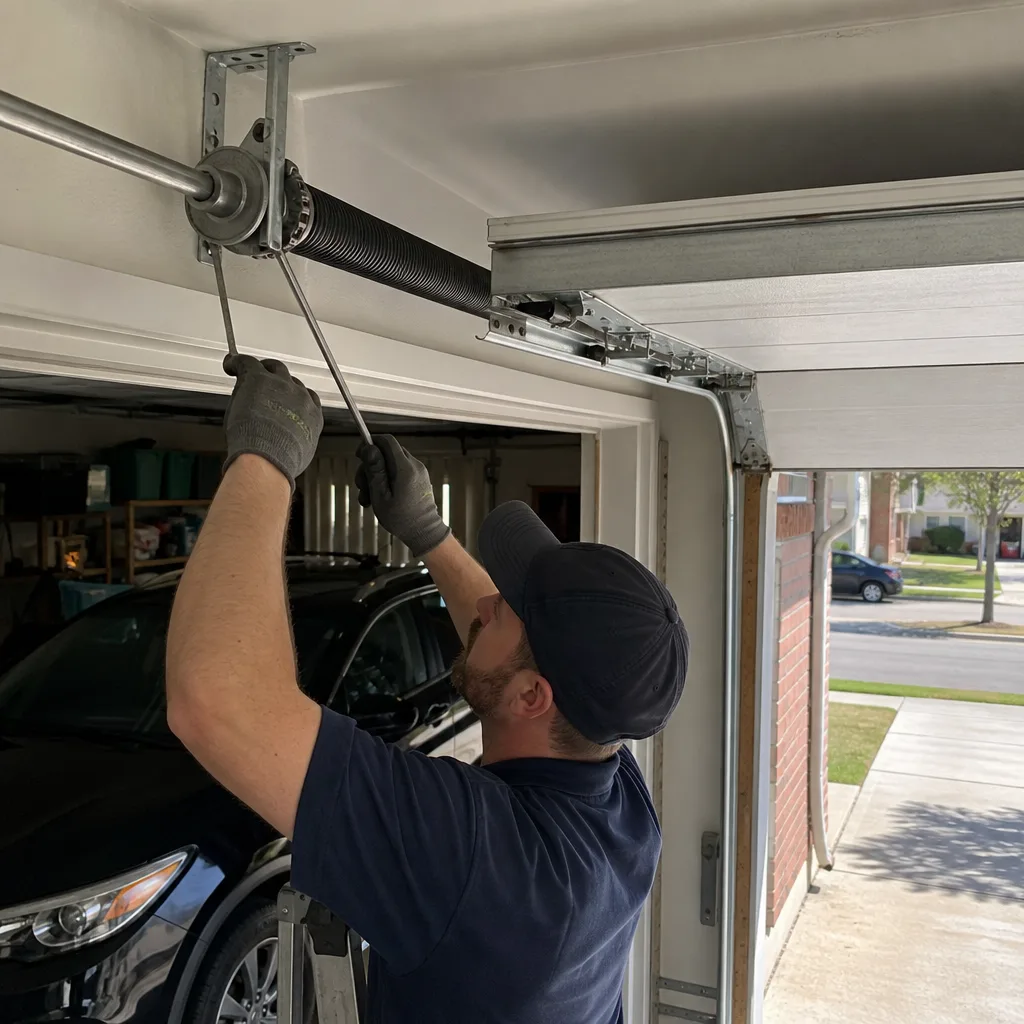
- Winding bars, solid steel inserts placed in the cogs of the winding cone, are the only safe way to add or release tension. Pliers, screwdrivers, or adjustable wrenches can slip, and when they do, the cone spins with force sufficient to break bone.
- A standard 0.250-inch wire spring stores roughly 1,500 pounds of pulling force. If the winding cone lets go, the bar becomes a projectile.
- The winding process requires simultaneous pressure on two bars, one inserted, one ready, with precise quarter-turn counting. Miscount by two turns and the door is dangerously over- or under-wound.
The professional-grade winding bars we carry are 18 inches of hardened steel, costing roughly $80 per pair, with specific diameter matching the cone bore. The “winding bars” sold in some retail kits are often shorter, softer steel, or the wrong diameter. They look similar. They are not.
This is not about homeowner competence. We’ve met plenty of Coppell homeowners who could learn this skill. The issue is that learning it requires practice, and practice on a live torsion spring is not a forgiving classroom.
Tasks That Require Trade Tools and Training
Beyond spring work, several other tasks sit firmly in professional territory. The common thread is either stored energy, structural load, or precision alignment that affects safety.
Cable replacement. The lift cables run from the bottom brackets to the cable drums at the spring shaft. When a cable frays or snaps, the remaining cable carries the full load unevenly. Bottom brackets are under spring tension even when the door is down. Removing the wrong bolt can release the bracket with force. We use locking pliers and specific sequence steps to secure the door before touching any bracket hardware.
Track realignment or replacement. The vertical and horizontal tracks must be parallel within 1/4 inch and plumb within 1/8 inch. A misaligned track causes the door to bind, wear rollers unevenly, and potentially jump the track entirely. Adjusting track brackets without understanding load distribution can twist the entire door system. In Coppell’s older homes near Old Town, where settling foundations are common, track alignment often reveals underlying structural issues that need addressing first.
Opener header bracket installation. This bracket anchors the opener’s rail to the wall above the door. It must be fastened into solid framing, typically a header board or the wall’s top plate, not drywall. A bracket that pulls loose drops the entire opener assembly, often onto a vehicle or person. Locating solid framing, using the correct lag bolts, and setting proper angle requires experience.
Spring sizing and selection. Springs are specified by wire diameter, inner diameter, length, and wind direction. The wrong spring cycles fewer times, wears faster, and can overstress the opener. We measure door weight, track radius, and drum type before specifying. A homeowner buying “the spring for a 16-foot door” at a retail counter is guessing with dangerous hardware.
Panel replacement on sectional doors. This seems straightforward, but panels are structural. Removing the wrong hinge sequence can collapse the door stack. New panels must match the existing gauge, profile, and insulation value, or the door’s wind load rating, relevant in North Texas storm country, is compromised.
The Hidden Cost of DIY Gone Wrong
The honest price comparison must include failure modes. We’ve responded to enough Coppell homes to see the patterns.
Misaligned track “repair.” A homeowner loosens track brackets to fix a binding door, shifts the track outward to clear, and retightens. The door now runs but the rollers ride the track edge, not the center. Six months later, the rollers are worn oval, the hinges are stressed, and the opener’s drive gear is stripped from the extra load. The repair that would have cost $180 for track adjustment and roller replacement now requires $340 in additional parts, plus the original issue still needs correct alignment.
Incorrect spring sizing. A homeowner installs a spring with the right length and diameter but wrong wire gauge, or the correct spring but two fewer turns. The door feels heavy, so the opener works harder. The opener’s motor or drive gear fails within a year. The $220 spring job becomes a $580 spring-plus-opener repair. In Coppell’s summer heat, an overworked opener fails faster still.
Bottom bracket bolt removed without securing the door. The bracket releases, the cable whips, and the door drops crooked in the opening. Now the door is jammed, potentially bent, and the car is trapped inside or outside. Emergency service call, after-hours rate, possible panel replacement. The original cable repair estimate of $160 becomes $600 or more.
Weatherstripping installed without checking door balance. New, thicker stripping adds friction. A door that was marginally balanced now drifts down or strains the opener. The homeowner doesn’t connect the new stripping to the opener’s new struggle. Six months later, the opener fails and the cause is missed.
These are not hypothetical. They are specific calls we’ve made in Coppell neighborhoods from Bethel School Road to Sandy Lake. The pattern is consistent: a small DIY saving creates a larger professional repair, often with collateral damage that wouldn’t have occurred with correct initial work.
North Texas Hardware Store Products: Trade-Grade vs. Consumer-Grade
Coppell homeowners have access to several retail options: Home Depot and Lowe’s in nearby Lewisville and Irving, Ace Hardware in Coppell itself, and various online sellers. The products available to consumers differ from trade-grade equivalents in specific, consequential ways.
Extension spring kits. Retail extension spring kits, the stretched springs running parallel to the horizontal tracks, often include safety cables, which is good. But the springs themselves are typically rated for 10,000 cycles at standard door weight. The springs we install are rated for 25,000 to 50,000 cycles, with precise calibration to door weight. A homeowner installing a retail kit on a solid-core or insulated door, common in Coppell’s newer construction, is under-sprung from day one.
Torsion springs at retail counters. Some North Texas hardware stores will order torsion springs by specification. The springs are often sourced from the same manufacturers we use. The difference is not the spring, it’s the knowledge to specify it correctly and the tools to install it safely. A correct spring installed incorrectly is still dangerous.
Opener kits. Retail Chamberlain, LiftMaster, and Genie openers are the same models we install, with one exception: the rail sections. Retail kits often include a three-piece rail; professional-grade units use a one-piece rail for rigidity. The difference matters on heavier doors or wider openings. For a standard 8-foot door in light use, the retail rail is adequate. For a 16-foot insulated door or a household with multiple daily cycles, the flex in a three-piece rail accelerates wear.
Cables and fittings. Retail cables are typically 7×19 strand, adequate for standard doors. We use 7×19 for light doors and 7×7 for heavier units, with specific termination fittings. The critical difference is knowing the correct cable length for the drum type and door height. Too long and the cable stacks improperly on the drum; too short and the door doesn’t fully open.
Lubricants. This is where retail and trade genuinely converge. A quality silicone spray from any hardware store, applied correctly, is the right product. We don’t sell a proprietary lubricant because there is no secret formula. Clean, light, consistent application is what matters.
Our assessment: for remote programming, weatherstripping, and lubrication, retail products are fully adequate. For springs, cables, and opener installation, the retail product may be correct but the installation knowledge and tools are the gap that creates risk.
The Middle Path: Helping Without Slowing Things Down
There is valuable ground between full DIY and standing aside. Here’s what genuinely reduces billable time, and what we’ve learned actually creates delay.
What helps:
- Clear the garage. Move vehicles out, create workspace around the door, and ensure the technician’s path from truck to door is unobstructed. In Coppell’s summer heat, this saves minutes that matter.
- Describe the symptoms precisely. “The door reverses two feet from the ground” is more useful than “it’s acting funny.” Note when the problem started, whether it’s consistent or intermittent, and any recent weather events.
- Have the opener manual and remote available. Programming a new remote without the learn button location costs time. The manual is usually available online if the physical copy is lost.
- Identify the door manufacturer if possible. A sticker on the interior panel edge or the track often shows the brand and model year. Amarr, Wayne Dalton, and Clopay use different hardware specifications that affect parts selection.
What slows things down:
- Disassembling components before the technician arrives. We often need to see the failure mode in place to diagnose correctly.
- Attempting to “hold” the door or spring during work. Our liability and your safety require that technicians control the work area.
- Pre-purchasing parts based on internet diagnosis. The part is often incorrect, and we cannot warranty customer-supplied components. Our trucks carry the correct inventory for most Coppell door configurations.
The most helpful homeowner is the one who observes carefully, describes accurately, and lets the technician work with full control of the process. This is not about trust; it’s about the sequence of safe work.
Cost Comparison: DIY vs. Professional in Coppell
Honest numbers require honest framing. Here is what each approach actually costs for common scenarios in the Coppell market, based on our experience and current retail pricing at North Texas stores.
| Task | DIY Material Cost | Professional Cost (Coppell) | Risk of DIY Failure |
|---|---|---|---|
| Weatherstripping replacement | $25-$45 | $120-$180 | Low; reversible |
| Full lubrication service | $15-$25 | $89 (Seasonal Tune-Up) | Very low |
| Remote/keypad programming | $0 (uses existing) | $75-$125 service call | Very low |
| Sensor alignment | $0 | $85-$150 | Low; reversible |
| Extension spring replacement (pair) | $60-$120 | $180-$280 | Moderate; injury risk |
| Torsion spring replacement | $80-$160 (spring only) | $220-$380 | High; serious injury risk |
| Cable replacement (pair) | $30-$60 | $160-$240 | High; bracket under tension |
| Opener installation | $200-$450 (retail kit) | $400-$700 (installed) | Moderate; header bracket risk |
| Track realignment | $0-$40 (hardware) | $150-$250 | Moderate; can cascade |
The professional column includes our standard pricing for Coppell. The DIY column assumes successful completion with no errors. When failure occurs, the effective DIY cost often exceeds professional service, sometimes significantly.
Our Garage Door Repair in Coppell service includes upfront pricing stated before work begins, with no surprise additions. The $89 Seasonal Tune-Up covers lubrication, balance check, safety reversal test, and hardware inspection, a reasonable middle ground for homeowners who want professional eyes on the system without a repair commitment.
Common Mistakes to Avoid
- Using a screwdriver as a winding bar. We’ve seen the aftermath in Coppell homes more than once. A flathead screwdriver inserted in a winding cone slips, the cone spins, and the homeowner suffers a hand or wrist injury. Winding bars are solid steel, specific diameter, inserted fully. Nothing else qualifies.
- Ignoring door balance after any adjustment. A properly balanced door stays at any height when disconnected from the opener. If your adjustment, new weatherstripping, or sensor realignment changes this behavior, the door is no longer safe. Test balance monthly by pulling the emergency release and lifting manually.
- Buying springs by door size alone. “Two-car garage door” is not a spring specification. Door weight, track radius, cable drum type, and spring configuration all matter. In Coppell’s variable construction, a 16-foot door can weigh 150 pounds or 350 pounds depending on insulation, windows, and material.
- Neglecting the emergency release. Homeowners test the opener’s safety reversal but forget the red emergency release cord. If the opener fails with the door down, this cord is your only manual exit. Pull it monthly to verify free operation, and ensure all household members know its location.
- Applying grease instead of silicone spray. Heavy grease, including white lithium, attracts dust and hardens in temperature swings. Coppell’s climate range, from 20°F winter lows to 105°F summer highs, is particularly hard on petroleum-based lubricants. Silicone spray remains effective across this range.
- Assuming a slow door means a failing opener. Often the door is simply out of balance or the tracks are binding, forcing the opener to work harder. Replacing the opener addresses the symptom, not the cause. A quick balance test, free and simple, reveals the truth.
- Working alone on any door repair. Even for “simple” tasks, a second person prevents the door from moving unexpectedly and can call for help if something goes wrong. This is not overcaution. It’s the standard our technicians follow on every job.
When to Call a Professional
Call a professional when the task involves stored energy, structural load, or precision alignment that affects safety. Specifically: any spring or cable work; track realignment or replacement; opener installation or header bracket work; panel replacement; and any situation where the door is stuck in a partially open position, creating security exposure.
Also call when you’ve attempted a repair and the door’s behavior has changed, even if the original symptom seems resolved. A door that now runs louder, slower, or with visible vibration is telling you something is still wrong.
Mainspring Garage Door Co. offers free estimates in Coppell. A technician will assess your door, explain what we find, and state a flat price before any work begins. No phone trees, no after-hours answering service. Call (972) 646-8653 and a live person will answer, 24 hours a day. Our trucks carry springs, cables, and openers for most major brands, including Wayne Dalton, Craftsman, and Raynor, so most jobs finish in a single visit. Every completed job is covered by our 90-Day Done Right Promise: if it’s not right, we return at no charge, in writing, with no dispute process.
Frequently Asked Questions
Torsion spring replacement in Coppell typically runs $220-$380, including parts, labor, and balance adjustment. Extension spring replacement is usually $180-$280. The exact price depends on spring size, door weight, and whether additional components like cables or bearings need attention. Call (972) 646-8653 for a free, exact quote with no obligation.
On a two-spring system, replace both. Springs installed together have cycled the same number of times and share wear patterns. Replacing one leaves an unmatched pair, with the older spring likely to fail soon after. The labor to access the springs is the majority of the cost, so doing both together is the sound approach. We quote torsion spring replacement as a pair by default.
Disconnect the opener using the red emergency release cord, then lift the door manually to waist height. A balanced door stays in place. If it drifts up or down, the springs need adjustment. Test this monthly. An unbalanced door strains the opener and creates safety risk. If your door fails this test, professional adjustment is warranted.
Garage door replacement in Coppell typically requires a building permit if the door opening is altered or if the new door changes the home’s wind load rating. Simple replacement in kind, same size and rating, often does not. We handle permit verification as part of our Garage Door Installation in Coppell service and can confirm requirements for your specific project during a free estimate.
A standard 10,000-cycle spring lasts roughly 7-10 years for typical residential use. Coppell’s temperature swings and humidity variation can accelerate corrosion on lower-grade springs. We install higher-cycle springs, rated for 25,000 to 50,000 cycles, which typically last 15-20 years even in North Texas conditions. The incremental cost is modest compared to the service life gained.
A careful homeowner with basic tools can install a retail opener kit on a standard 8-foot, lightweight door. The critical step is securing the header bracket into solid framing, not drywall, with correct lag bolts. For 16-foot doors, insulated doors, or any door with balance concerns, professional installation is the safer choice. We install and service all major brands, including Amarr and Wayne Dalton compatible openers, with full warranty coverage. See our Garage Door Opener in Coppell page for details.
The Bottom Line
The DIY-or-professional question is not about capability; it’s about risk assessment and tool access. Coppell homeowners can safely maintain their doors through lubrication, weatherstripping, sensor care, and remote programming. Spring work, cable replacement, track alignment, and opener header installation belong to trained technicians with proper tools. The money saved on a DIY spring repair disappears quickly if the spring is wrong, the winding slips, or secondary damage follows. A square deal means knowing which tasks are genuinely yours and which are genuinely ours. We’ve been drawing that line honestly since 1984, and we stand behind every call we make. For more guides & resources, visit our blog.
Written by Carl Dutton, Owner at Mainspring Garage Door Co., serving Coppell since 2016.