
Last updated September 10, 2026
Full 25-point door and opener safety check with every visit - springs, cables, rollers, tracks, and your LiftMaster or Chamberlain opener included
You get a price before we start. It does not change when the truck arrives.
 Before
 After
After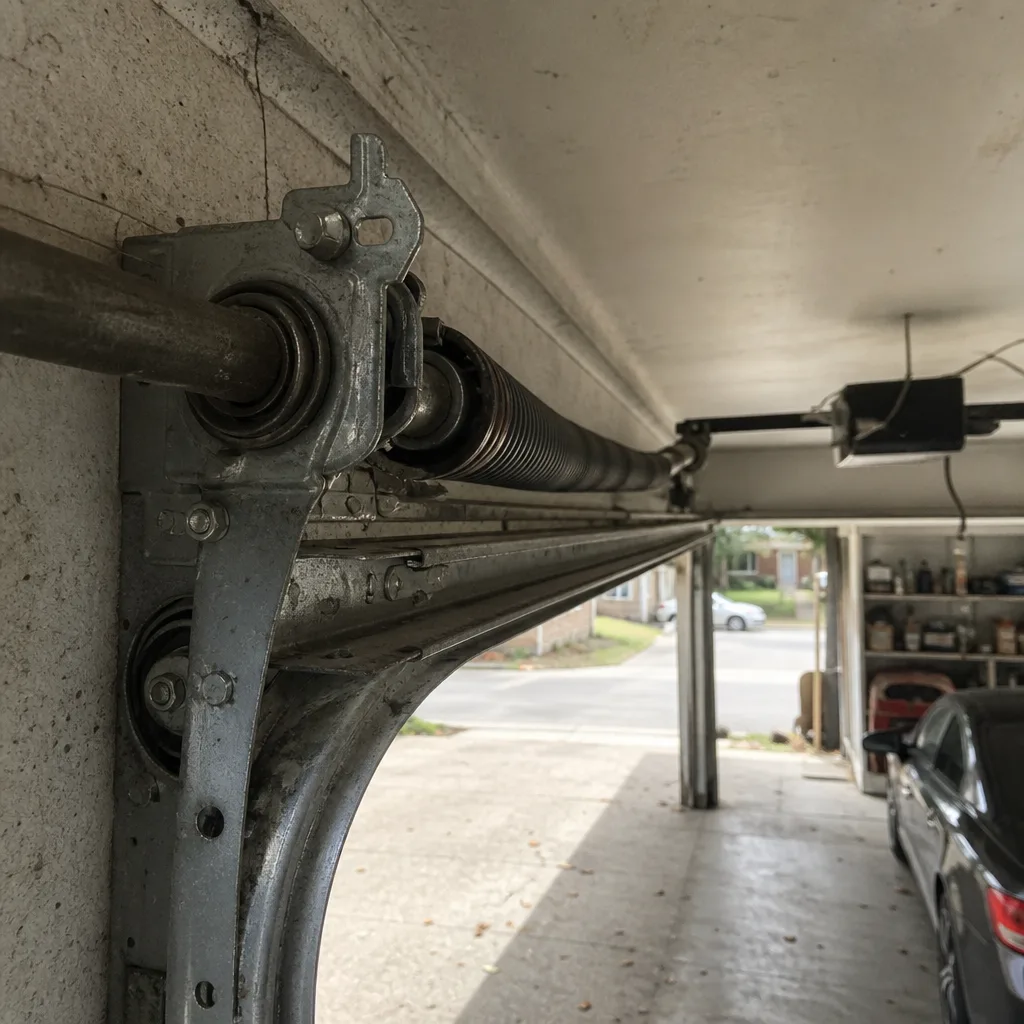 Before
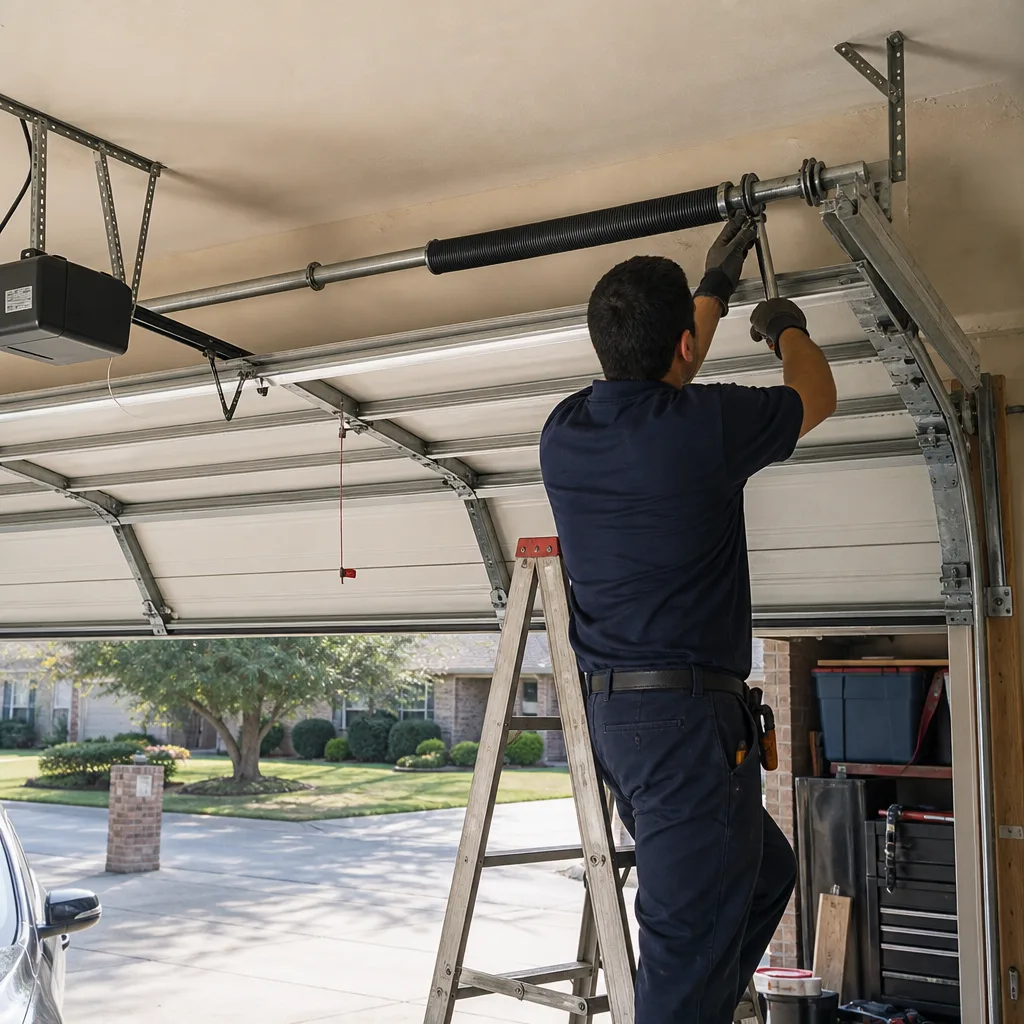 After
After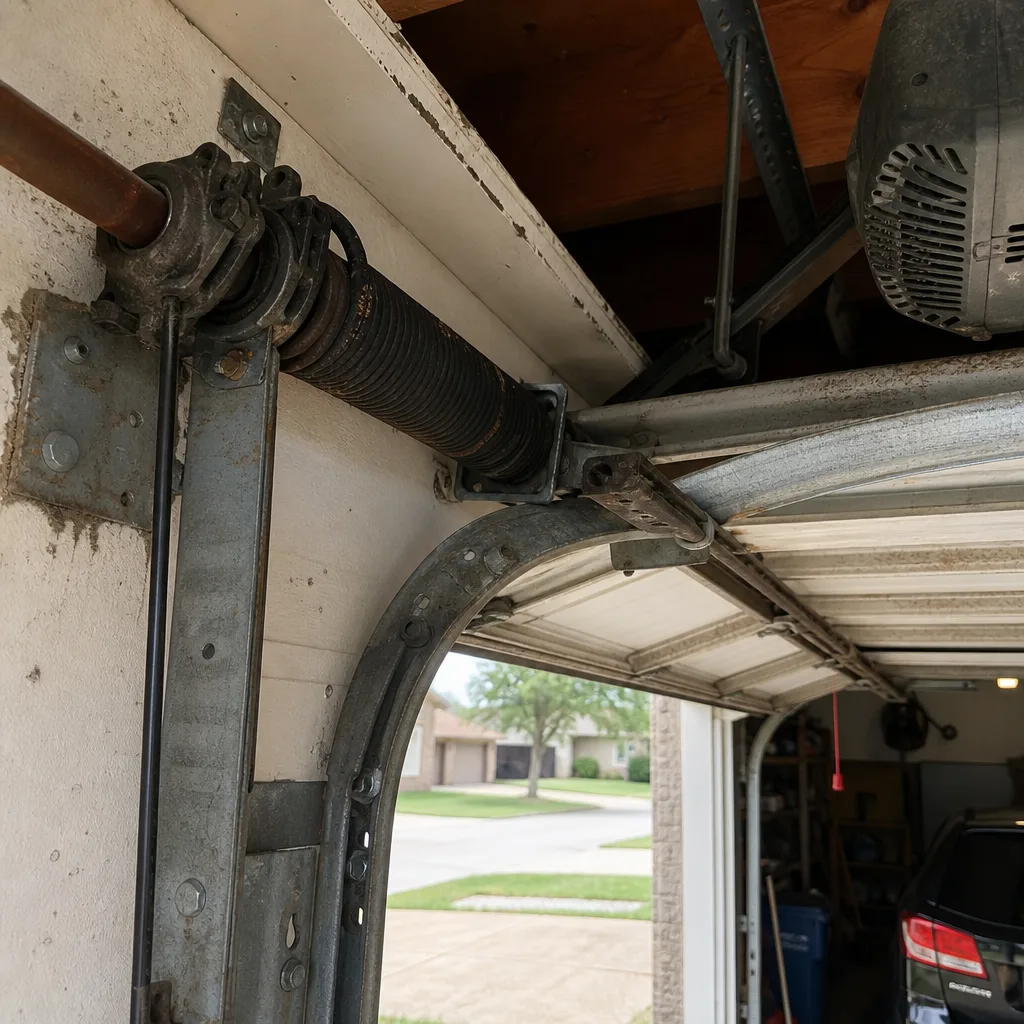 Before
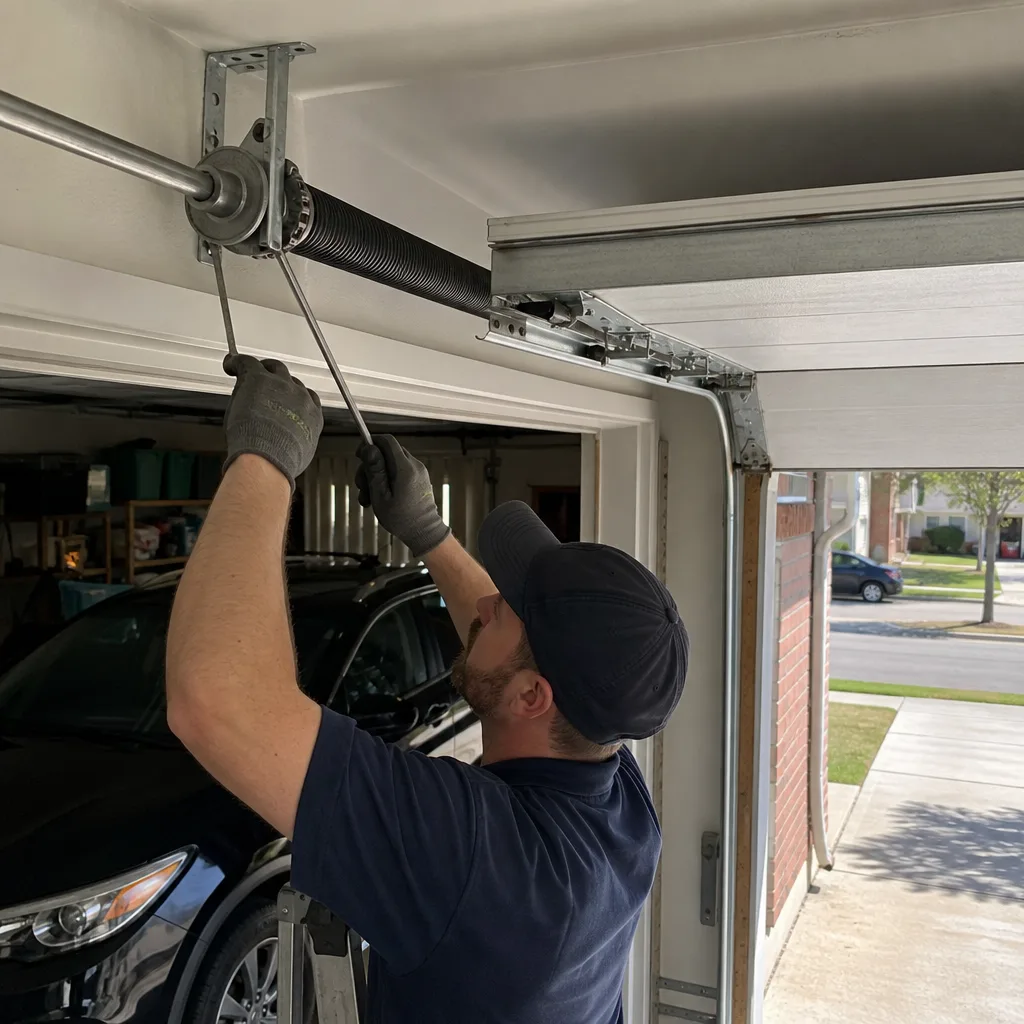 After
AfterGarage Door Warning Signs: A Coppell Homeowner’s Reference Guide
Most garage door failures in Coppell announce themselves weeks in advance, but the grinding noise on the way down and the grinding noise on the way up sound identical to most homeowners. One points to the opener drive gear. The other points to the torsion spring bearing plate. They are not the same repair, and knowing the difference can keep you from paying for the wrong fix. This guide maps every sound, movement, and visual cue to its source component, so you can describe what you’re seeing with the precision of someone who knows the machine. For a broader overview, see The Complete Guide to Garage Door in Coppell.
Quick Answer
A failing garage door in Coppell typically shows one or more of these warning signs: grinding or popping during operation, sagging or jerking movement, gaps in the torsion spring coils, frayed cables with rust streaking, or a door that has slowed down without obvious cause. Most of these symptoms trace to a specific component, and catching them early converts a $180 spring adjustment into a repair instead of a $1,400 door replacement. Our Seasonal Garage Door Care for Coppell: Year-Round Homeowner’s Guide explains when to schedule these inspections.
Table of Contents
- Sound Index: What Each Noise Means
- Movement Abnormalities and Their Sources
- Visual Signs on Springs and Cables
- Why a Slow Door Is Usually a Spring Problem
- How Coppell’s Climate Hides Warning Signs
- Urgent Warning Signs vs. Scheduled Repairs
- Common Mistakes to Avoid
- When to Call a Professional
- Frequently Asked Questions
Sound Index: What Each Noise Means
We have answered thousands of calls in Coppell, and the first thing a homeowner says is almost always a sound description. The problem is that “grinding” covers three different failures, and “popping” covers two. Here is how to separate them.
Grinding on the Way Down
When the door descends and you hear a low, continuous grind that starts after the door is already moving, the source is usually the torsion spring bearing plate. This plate sits at the center of the spring tube above the door, and its nylon bearings dry out over years of Texas heat cycles. The sound is mechanical and rhythmic, matching the rotation of the tube.
In Coppell’s older neighborhoods like Old Town Coppell and the original ranch homes along Bethel School Road, we see this frequently on doors installed in the 1990s that still have their original hardware. The bearing plate is a $40 part and thirty minutes of labor. Left alone, the grinding accelerates wear on the spring itself and can score the tube.
Grinding on the Way Up
Grinding during ascent that starts the moment the opener engages is typically the opener’s drive gear. On chain-drive openers, this is the nylon gear inside the motor head that meshes with the worm drive. On belt-drive units, it is the sprocket or the belt tensioner. The sound is higher-pitched than bearing-plate grinding and often accompanied by shuddering.
We carry replacement drive gears for LiftMaster, Chamberlain, and Genie openers on every truck, because this is a same-day repair if caught early. If the gear strips completely, the motor runs but the door does not move, and the repair becomes an opener replacement.
Popping or Banging
A single loud pop, especially in the morning or after the door has sat unused for hours, is almost always a torsion spring settling into a new position. This is the sound of spring coils rubbing against each other where the inner surface has corroded. It means the spring has lost its factory lubrication and is experiencing inter-coil friction.
In Coppell, where humidity swings between 40% and 85% through a typical year, this corrosion happens faster than in drier climates. The pop is a warning that the spring is cycling with increased friction, which generates heat and accelerates metal fatigue. A popping spring does not fail immediately, but it is living on borrowed time. We track these with homeowners and schedule replacement before the break.
Scraping or Rubbing
A continuous scrape along one side of the door track indicates a misaligned vertical track or a worn roller. The sound is metallic and localized, and you can often feel vibration in the wall near that track. On doors in Coppell’s newer construction, particularly the homes built during the 2000s building boom, we find this caused by settling foundations that have shifted the track brackets by as little as an eighth of an inch.
Squealing
High-pitched squeal during operation points to dry rollers or hinges. Steel rollers without ball bearings squeal first; nylon rollers squeak rather than squeal. This is the least urgent sound on this list, but it is also the one that masks other problems. A homeowner who lubricates the rollers and stops the squeal may miss the grinding bearing plate underneath.
Sound-to-Component Reference
| Sound | When It Happens | Likely Component | Urgency |
|---|---|---|---|
| Low grinding | During descent | Torsion spring bearing plate | Schedule within 2 weeks |
| High grinding | During ascent | Opener drive gear | Schedule within 1 week |
| Single pop/bang | First cycle of day | Torsion spring (corroded) | Monitor; plan replacement |
| Continuous scrape | Both directions | Track alignment or roller | Schedule within 2 weeks |
| High squeal | Both directions | Dry rollers or hinges | Address at tune-up |
Movement Abnormalities and Their Sources
A garage door that moves wrong is telling you exactly where to look. The key is matching the movement pattern to the mechanical cause.
Sagging on One Side
When the door sits with one corner lower than the other, or rises unevenly with one side leading by several inches, the cause is almost always a failing spring on the low side. Torsion spring systems use one or two springs across the header; if one spring has lost tension through stretching or metal fatigue, that side of the door carries less assist.
In Coppell, we see this pattern most often on the 16-foot wide doors common in the MacArthur Estates and Riverchase subdivisions. These wide doors require higher spring tension, and the springs work harder on the side that faces afternoon sun. The low corner is your diagnostic: it is the side with the weaker spring.
Operating a door with a sagging side strains the cables, the opener rail, and the door panels themselves. The panels can develop a permanent twist that requires panel replacement or full door replacement. This is why we treat sagging as a stop-use condition until the spring is replaced.
Jerking or Stuttering
A door that moves in fits and starts, or pauses mid-travel, is usually experiencing intermittent binding in the track system. The causes include:
- A bent horizontal track section, often from impact with a vehicle bumper or stored ladder
- A worn roller that seizes in its stem and then releases
- A loose track bracket that allows the track to shift under load
- Debris in the track, particularly dried mud or gravel tracked in from Coppell’s unpaved alleyways in older sections
The diagnostic test is manual operation. Disconnect the opener using the red release handle and lift the door by hand. If it still jerks, the problem is in the door system. If it moves smoothly, the opener is the source, and the issue is likely a failing circuit board or limit switch.
Reversing Before Closing
A door that reaches the floor and immediately reverses, or reverses partway down, is triggering the safety reversal system. Modern openers since 1993 are required to reverse on obstruction detection. The causes include:
- Misaligned or dirty photo eyes (the small sensors near the floor on each track)
- Excessive friction in the door system that the opener interprets as an obstruction
- Incorrect down-force sensitivity setting on the opener
- Binding in the bottom section, often from a dented panel or worn bottom seal dragging
In Coppell’s established neighborhoods, we find photo eye misalignment caused by lawn equipment, basketballs, or children more often than component failure. The fix is often a simple realignment. But if the eyes are clean and aligned and the door still reverses, the underlying friction must be found before the opener burns out from repeated overload.
Movement-to-Component Reference
| Movement | Check First | Check Second |
|---|---|---|
| Sagging left or right | Torsion spring tension (low side) | Cable length or drum position |
| Jerking in both directions | Track debris or damage | Worn rollers |
| Jerking only with opener | Opener force settings | Opener drive gear wear |
| Reverses before closing | Photo eye alignment | Door friction or binding |
Visual Signs on Springs and Cables
The components above your head show failure patterns that are visible if you know what to look for. We encourage Coppell homeowners to inspect their spring and cable system monthly, from a safe distance, with the door closed.
Torsion Spring Warning Signs
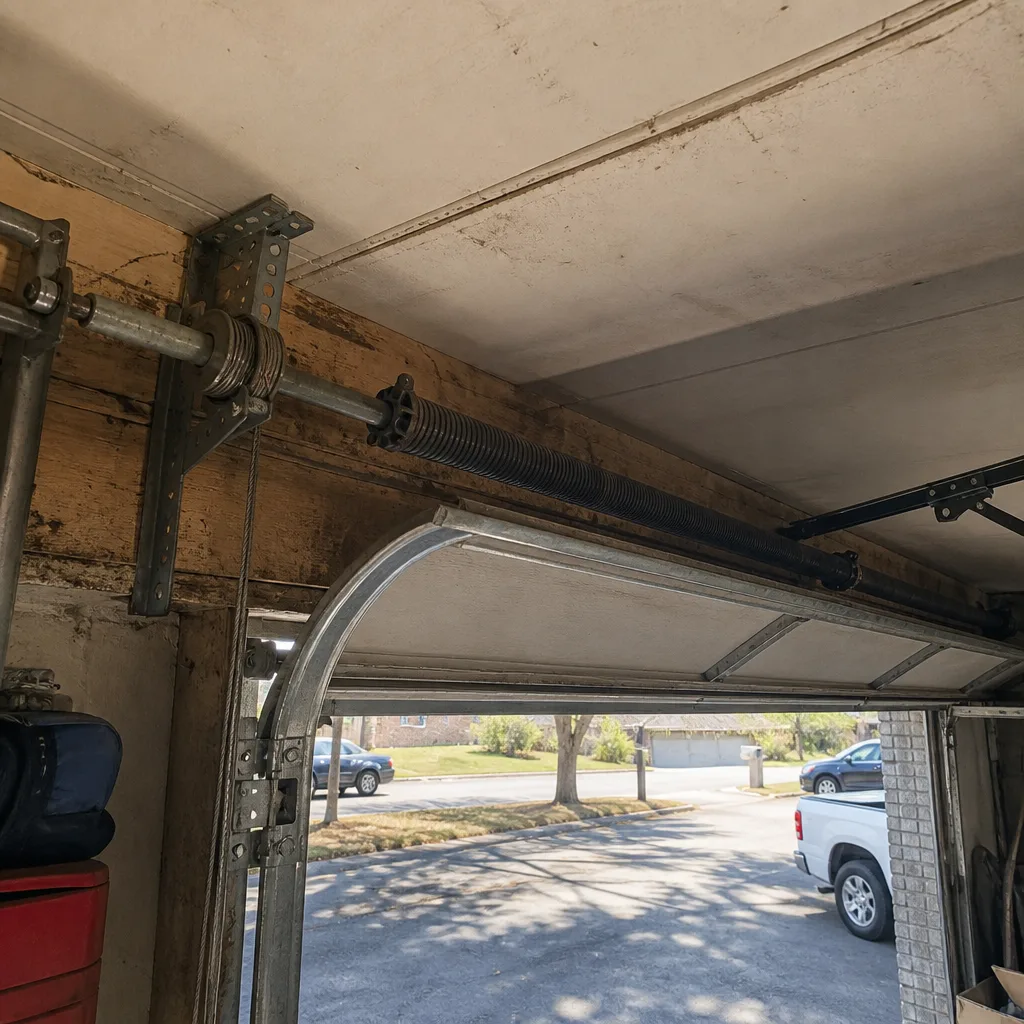
Torsion springs are the tightly wound coils above the door header. They carry the full weight of the door, and when they fail, they release that energy suddenly. These are high-tension components, and we do not recommend close inspection or any contact. Observe from the doorway, never from directly beneath.
Coil gap changes: A healthy torsion spring has coils that sit evenly spaced when the door is closed. If you can see a visible gap between two coils that exceeds the uniform spacing, that section of spring has stretched and lost tension. We call this a “set” in the spring, and it means the spring is operating below its engineered capacity.
Rust streaking: Orange or brown streaks running down the spring coils indicate corrosion between the inner surfaces of the wire. This is the same corrosion that causes the popping sound described earlier. In Coppell, where summer humidity lingers in garages with poor ventilation, we see this on north-facing garage doors that never receive direct sun.
Coil separation at rest: When the door is fully closed, the spring should still show some tension in its coils. If the spring appears completely relaxed with coils visibly separated, it has lost all effective tension. The door is being held entirely by the opener, which is not designed for continuous load. This is a stop-use condition.
Cable Warning Signs
The lift cables run from the bottom corners of the door to the drums at each end of the spring tube. They are aircraft-grade steel wire rope, but they fatigue over years of flexing around the drums.
Fraying patterns: A single broken wire in the cable braid is not immediate cause for replacement, but it indicates the cable is entering its wear phase. Multiple broken wires, or broken wires concentrated at the drum end or bottom bracket, indicate the cable is approaching failure. The drum-end fraying happens because that section bends around the smallest drum diameter on every cycle.
Rust streaking on cables: Unlike spring rust, cable rust is more dangerous because cables are thinner and less tolerant of section loss. Rust-colored dust or flakes near the bottom bracket or drum indicates internal corrosion that weakens the cable unpredictably.
Cable unwinding from drum: If you can see cable hanging loose or improperly seated on the drum, the door is out of balance and the cable may slip completely. Do not operate the door. This condition can cause the door to drop on one side and jam in the tracks, or worse.
Photographing for Your Repair Call
If you observe any of these visual signs, a photograph from the doorway helps us prepare the right parts. Include the full spring assembly in one shot, and a close view of any specific concern in another. We can often identify the spring wire size and length from a clear photo, which means we arrive with the exact replacement instead of measuring on site.
Why a Slow Door Is Usually a Spring Problem
This is the most expensive misdiagnosis we correct in Coppell. A homeowner notices the door takes longer to open, or seems to strain on the way up, and concludes the opener is failing. They receive a quote for opener replacement, sometimes $400 to $700, when the actual problem is a spring that has lost 15% of its tension.
The spring-opener relationship is simple but widely misunderstood. The springs carry the door’s weight. The opener provides guidance and the final few inches of lift. When springs are properly tensioned, a garage door weighs between 8 and 12 pounds at the opener rail, regardless of its actual 150 to 300 pound mass. When springs weaken, that apparent weight increases to 40, 60, or 100 pounds.
The opener senses this load. Its motor runs longer, works harder, and may overheat. The door moves slower because the opener’s safety logic reduces speed to protect the motor. The homeowner sees a slow door and blames the opener.
The correct diagnostic is a spring tension test, which we perform with the door disconnected from the opener. If the door does not stay at waist height when released, or requires significant force to lift, the springs are the cause. A spring adjustment or replacement in Coppell typically runs $180 to $340. An unnecessary opener replacement runs $550 to $900 installed.
We have restored proper spring tension on doors in Coppell’s Sutton Fields and Coppell Woods neighborhoods where the previous diagnosis was opener failure. The opener was fine. It was simply being asked to do the spring’s job. After the spring work, the door moved at original speed and the opener stopped overheating.
This is why we offer a free second opinion on any written estimate for garage door repair in Coppell. The $80 fix misdiagnosed as the $400 fix is more common than it should be.
How Coppell’s Climate Hides Warning Signs
Coppell sits at the edge of the Blackland Prairie with clay-heavy soils and humidity that fluctuates sharply between seasons. These conditions create warning signs that homeowners in drier climates do not experience, and they mask problems that would be obvious elsewhere. If you’re planning larger work, read How to Hire a Garage Door Contractor in Coppell: A Step-by-Step Guide first.
Humidity Infiltration Through Weatherstripping
The bottom seal and perimeter weatherstripping on a garage door compress and harden over five to seven years of Texas sun. Once the seal is compromised, summer humidity enters the garage and condenses on the cooler concrete floor and metal components. This moisture does two things: it accelerates spring and cable corrosion, and it increases the effective weight of wooden or insulated steel door panels as they absorb moisture.
The hidden warning sign is opener strain before visible rot. A wooden door in Coppell’s older homes, particularly the cedar-sided ranches near Grapevine Lake, can gain 20 to 30 pounds of water weight in humid months. The opener works harder, cycles slower, and may trip its thermal overload. The homeowner replaces the opener when the door simply needs resealing and spring tension adjustment for the new weight.
We check weatherstripping on every service call and include it in our $89 Seasonal Tune-Up. Replacing a bottom seal is $45 to $85 in most cases, and it prevents the humidity damage that destroys springs prematurely.
Foundation Movement and Track Alignment
Coppell’s clay soils expand and contract dramatically with moisture. A garage slab that was level in March may have settled differentially by August. This movement shifts the vertical door tracks, which are anchored to the garage framing and the slab. The warning sign is intermittent binding that comes and goes with the seasons.
We see this most in the Creekside and Lakeside subdivisions built during the 1990s, where expansive clay was not fully compensated in foundation design. A door that binds in summer and frees in winter is telling you the foundation is moving, and the track brackets need seasonal adjustment. Ignoring this pattern damages rollers and eventually bends the tracks.
Thermal Cycling of Openers
Uninsulated garages in Coppell reach 115°F in July and drop below freezing in January. These extremes stress opener electronics. The warning sign is erratic behavior that does not correlate with any mechanical issue: the opener works fine at 9 AM but fails at 3 PM, or operates normally in winter but reverses randomly in summer. For more guides & resources on diagnosing these patterns, visit our blog.
The circuit board’s capacitors and relays are temperature-sensitive. We carry replacement logic boards for major brands including LiftMaster, Chamberlain, and Genie, and we can often diagnose thermal failure by testing the opener at temperature extremes.
Urgent Warning Signs vs. Scheduled Repairs
Not every warning sign demands immediate service. Some allow you to plan. Others require stopping use of the door and calling for emergency response. The distinction matters for your safety and your schedule.
Stop Using the Door Immediately
- A broken spring with visible coil separation or a gap where the spring has snapped. The door is unsupported and may fall if released from the opener.
- A cable off the drum or visibly frayed with multiple broken wires. Cable failure allows the door to drop on one side.
- A door that has come out of the tracks on one or both sides. The panels can fold or collapse.
- Any grinding or popping accompanied by visible door panel flex or twist. The structural integrity is compromised.
These conditions are genuine emergencies. Mainspring Garage Door Co. answers calls with a live person 24/7, including nights, weekends, and holidays, and we stock the parts to complete most emergency repairs in a single visit.
Schedule Within One to Two Weeks
- Grinding bearing plate or opener drive gear. These will fail completely but do not present immediate safety risk.
- Sagging door with still-functional spring on one side. The door operates but is damaging other components.
- Reversing door with clear photo eye misalignment. A nuisance and opener strain, but not dangerous if you hold the wall button to override.
- Slow operation with no other symptoms. Likely spring tension loss, which worsens gradually.
Address at Next Tune-Up
- Squealing rollers or hinges. Noise only, no mechanical degradation yet.
- Minor weatherstripping gaps. Gradual humidity infiltration, not immediate damage.
- Cosmetic rust on hardware with no functional effect. Monitor, do not rush.
The 90-Day Done Right Promise applies to every repair we complete, whether emergency or scheduled. If it is not right, we return at no charge. This is stated in writing on every job, with no dispute process.
Common Mistakes to Avoid
- Ignoring seasonal changes as “just settling.” In Coppell, a door that binds in August and frees in November is not settling. It is foundation movement affecting track alignment, and it will bend the tracks if unaddressed.
- Lubricating the torsion spring. WD-40 or general-purpose lubricant on a torsion spring attracts dust and creates a grinding paste that accelerates wear. Springs require specific garage door spring lubricant, applied sparingly, or no lubrication at all.
- Replacing the opener for slow operation without testing springs. This is the $400 mistake described above. Always disconnect the door and test manual operation before blaming the opener.
- Continuing to use a door with one broken spring. On two-spring systems, the remaining spring carries double load and will fail catastrophically, often within days. On single-spring systems, the door is a safety hazard.
- Attempting cable or spring repair as DIY. These are high-tension components that can cause serious injury or death. We do not provide step-by-step instructions for these repairs because the risk is genuine and the training requirement is real.
- Accepting a phone quote without inspection. A grinding noise described over the phone could be three different repairs with three different prices. We provide exact quotes only after inspection, and our estimates are free.
- Waiting for complete failure. A spring that is popping and showing rust streaks will fail. The only question is whether it fails during a scheduled replacement or at 6 AM when you are leaving for a flight. Scheduled replacement costs less and carries no inconvenience premium.
When to Call a Professional
Call when you observe any warning sign that matches the urgent category above, or when you cannot confidently identify the source of a sound or movement. A professional inspection takes twenty minutes and removes the guesswork.
We have served Coppell homeowners for over 42 years, since 1984, and we have seen every failure pattern this guide describes. Our technicians arrive in uniform, background-checked, with springs, cables, and openers for all major brands already on the truck. Most repairs are completed in a single visit, and the flat price is stated before any work begins.
Mainspring Garage Door Co. offers free estimates in Coppell. Call (972) 646-8653 to schedule. If you are comparing quotes, remember our standing offers: $50 off any repair over $250, a free second opinion on any written estimate, and a permanent 5% discount for seniors and veterans.
Frequently Asked Questions
Garage door spring repair in Coppell typically costs between $180 and $340 for a standard torsion spring replacement, including parts, labor, and adjustment of door balance. The exact price depends on the spring wire size, door weight, and whether one or both springs require replacement. We state the flat price before any work begins, and estimates are free. Call (972) 646-8653 for an exact quote.
A garage door should not be operated with a broken spring. On a two-spring system, the remaining spring is overloaded and will fail soon, often dangerously. On a single-spring system, the door is unsupported and may fall if the opener releases or a cable slips. Discontinue use and call for repair. This is not a DIY repair; torsion springs carry lethal tension.
The most common cause is misaligned or obstructed photo eyes, the safety sensors near floor level on each track. Clean the lenses, check for alignment, and verify nothing blocks the beam. If the eyes are clear and aligned, the cause is excessive friction in the door system or incorrect down-force settings on the opener. A technician can distinguish these in minutes during a free inspection.
We recommend a professional inspection and tune-up annually, and every six months for doors on north-facing garages or in areas with high humidity exposure. Our $89 Seasonal Tune-Up includes spring tension check, hardware tightening, roller inspection, track alignment, opener force testing, and weatherstripping evaluation. Annual service catches the warning signs this guide describes before they become emergency repairs.
No. Mainspring states the flat price before any work begins, and that price does not change unless you authorize additional work. We do not charge diagnostic fees or trip charges for estimates within our service area. The quote you approve is the amount on the invoice. This is part of our no-surprises commitment.
Yes. Our trucks are stocked with springs, cables, rollers, and opener components for all major brands including Raynor, LiftMaster, Chamberlain, and Genie, plus Clopay, Amarr, Wayne Dalton, and Craftsman door hardware. Most repairs are completed in a single visit without waiting for parts. If your door or opener uses a specialized component, we identify it during the inspection and schedule prompt completion.
If any repair we complete is not right, we return and make it right at no charge. This is stated in writing on every job. There is no paperwork to file, no dispute process, and no expiration within the 90 days. We stand behind the work because we intend to do it correctly the first time.
The Bottom Line
Garage doors do not fail without warning. They grind, pop, sag, slow, and show rust. The homeowner who learns these signals, and matches each to its source component, avoids the wrong repair and the emergency call. In Coppell’s climate of humidity swings and foundation movement, the warnings often appear earlier and mean more than they would elsewhere. Inspect your door monthly. Note the sounds and movements. When a warning sign appears, describe it precisely, or call for an inspection that will. The $180 repair you schedule today is the $1,400 replacement you prevent next year.
Written by Carl Dutton, Owner at Mainspring Garage Door Co., serving Coppell since 2016.